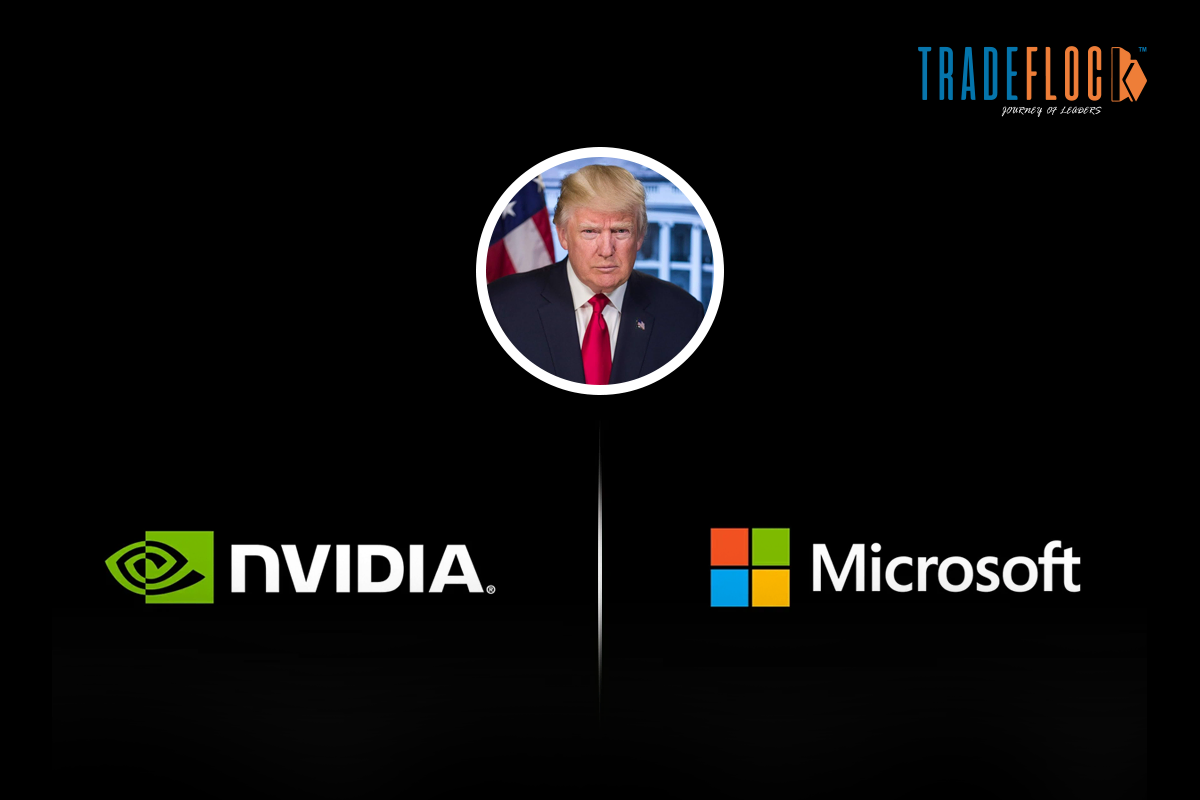
While some corporate giants have made their stance on President Donald Trump loud and clear, two of the biggest names in tech—Microsoft and Nvidia—are taking a far more subtle, calculated approach. Unlike companies such as Apple and Google, which have publicly clashed with Trump over issues ranging from immigration policies to tariffs, Microsoft and Nvidia have opted for quiet engagement rather than outright confrontation. But why are these two powerhouse companies choosing discretion over drama, and what does it mean for their future in a politically volatile landscape?
A Deliberate, Low-Key Strategy
Microsoft and Nvidia have mastered maintaining strong government relationships without making headlines. Satya Nadella, Microsoft’s CEO, has consistently positioned the company as a politically neutral force, prioritizing long-term strategy over reactionary corporate activism. Similarly, Jensen Huang, Nvidia’s CEO, has largely avoided political controversy, focusing instead on maintaining Nvidia’s dominance in the artificial intelligence and semiconductor industries.
In contrast, other tech CEOs have openly opposed Trump’s policies. Apple’s Tim Cook has publicly criticized Trump’s stance on climate change and immigration, while Meta’s Mark Zuckerberg has engaged in a highly publicized battle over social media regulations. Microsoft and Nvidia, however, have adopted a more pragmatic.
Microsoft’s Tactical Engagement
Microsoft’s relationship with Trump has been carefully managed. Unlike Amazon, which clashed with Trump over federal contracts and faced public attacks from the former president, Microsoft strategically navigated government contracts with minimal controversy. The company secured a $10 billion Pentagon cloud computing contract (JEDI), edging Amazon Web Services. While Trump’s involvement in the bidding process was questioned, Microsoft avoided public spats and focused on government partnerships.
Additionally, Microsoft has maintained an open line of communication with policymakers on issues such as cybersecurity, AI regulations, and digital infrastructure. This approach has enabled the company to shape policy discussions without alienating key political figures.
Nvidia’s Calculated Approach to Policy
Nvidia’s ascent as a leader in AI and semiconductors has coincided with heightened US-China tensions. Unlike companies like Tesla, which faced Trump’s direct scrutiny over manufacturing decisions, Nvidia has sidestepped political landmines by focusing on innovation and staying relatively quiet on divisive issues.
One of the biggest challenges for Nvidia has been navigating U.S. export restrictions on advanced AI chips to China. Rather than openly opposing Trump-era trade policies, Nvidia has worked discreetly with policymakers to mitigate restrictions while ensuring compliance. This approach has allowed the company to maintain access to key markets without becoming embroiled in political disputes.
The Risks and Rewards of Staying Quiet
Microsoft and Nvidia have reaped significant benefits by opting for a quieter approach. They have continued securing government contracts, avoided becoming political punching bags, and maintained steady growth in their respective industries. However, this strategy has risks.
In an era where corporate activism is increasingly expected, some critics argue that Microsoft and Nvidia’s silence on controversial political issues could be seen as tacit approval. For example, while other tech companies took a strong stance against Trump’s handling of the Capitol riots, Microsoft and Nvidia remained relatively restrained in their responses.
Moreover, as Trump remains a dominant figure in U.S. politics, there is always the possibility that staying silent could backfire. With Trump returning to power in 2025, tech companies that have been vocal critics find themselves at odds with the administration, while those that have taken a quieter approach—like Microsoft and Nvidia—are better positioned to navigate shifting political landscapes.
The Future of Corporate-Government Relations
Tech giants’ strategy of staying quiet offers a case study in corporate diplomacy. Rather than engaging in public battles, they have demonstrated that working quietly behind the scenes can be just as effective—if not more so—than making bold political statements.
As tech regulation, AI governance, and geopolitical tensions continue to evolve, Microsoft and Nvidia’s ability to maintain a balanced, non-confrontational approach may serve as a model for other corporations navigating uncertain political terrain. While companies like Apple and Google make headlines for their political clashes, Microsoft and Nvidia are proving that the quietest voice in the room can sometimes be the most influential.